

The businesses that thrive over the next decade won't simply use AI tools. They'll become AI-native organisations, built around connected intelligence, not just equipped with it.
That was the idea at the centre of our recent event at Easter Road Stadium on Thursday 28th of May, where Dunedin IT brought together clients, partners, and business leaders to explore what AI really means for the future of business.
Moving Beyond the AI Hype
Over the last few years, AI conversations have largely centred around individual tools, chatbots, copilots, automation platforms, often with promises of saving time and boosting productivity.
While these tools have value, they can distract from a more important conversation.
The real opportunity isn't simply adopting AI. It's understanding how AI can connect information, improve decision-making, and create a more intelligent organisation.
Think Octopus, Not Tools
.jpg)
The key message from the day came from a concept introduced by Jamie (Dunedin IT Managing Director): Think Octopus.
Most businesses already have the information they need to make better decisions. The challenge is that it's spread across multiple systems and departments.
Imagine an octopus with a central brain connected to multiple arms. The brain acts as an intelligence layer, while each arm represents a system or process; CRM, finance, helpdesk, documents, project management. Rather than operating in isolation, each arm feeds information into the wider business.
This isn't about replacing people. It's about ensuring the right information reaches the right people at the right time.
The question shifts from "What AI tool should we buy?" to "How do we connect our business so AI can deliver real value?"
AI-Native Business
.jpg)
In a traditional business, information is fragmented. Teams manually gather reports, forward emails, and share knowledge between departments.
In an AI-native business, information flows into a central intelligence layer where it can be queried and acted upon. Leaders can ask what projects are at risk, which customers haven't been contacted, or which opportunities are most likely to close, and get answers drawn from live data across the whole business.
This is the direction the world's leading organisations are moving towards. The question for SMEs is whether to start building those foundations now, or catch up later under pressure.
The Role of Microsoft, Egnyte and Giacom
.jpg)
Our partners added important layers to this picture.
Microsoft and Giacom covered Copilot and the broader Microsoft ecosystem, tools that automate tasks and make information more accessible. Egnyte focused on the foundation beneath those tools: ensuring data is organised, secure, and ready for AI to use. They also demonstrated AI capabilities Dunedin IT has already put to work, including image recognition tools that can automatically analyse site photographs, generate descriptions, and geolocate images on a map.
.jpg)
The consistent message across all three: AI is only as good as the information it can access, and the greatest value comes when systems work together.
An Idea Four Years in the Making
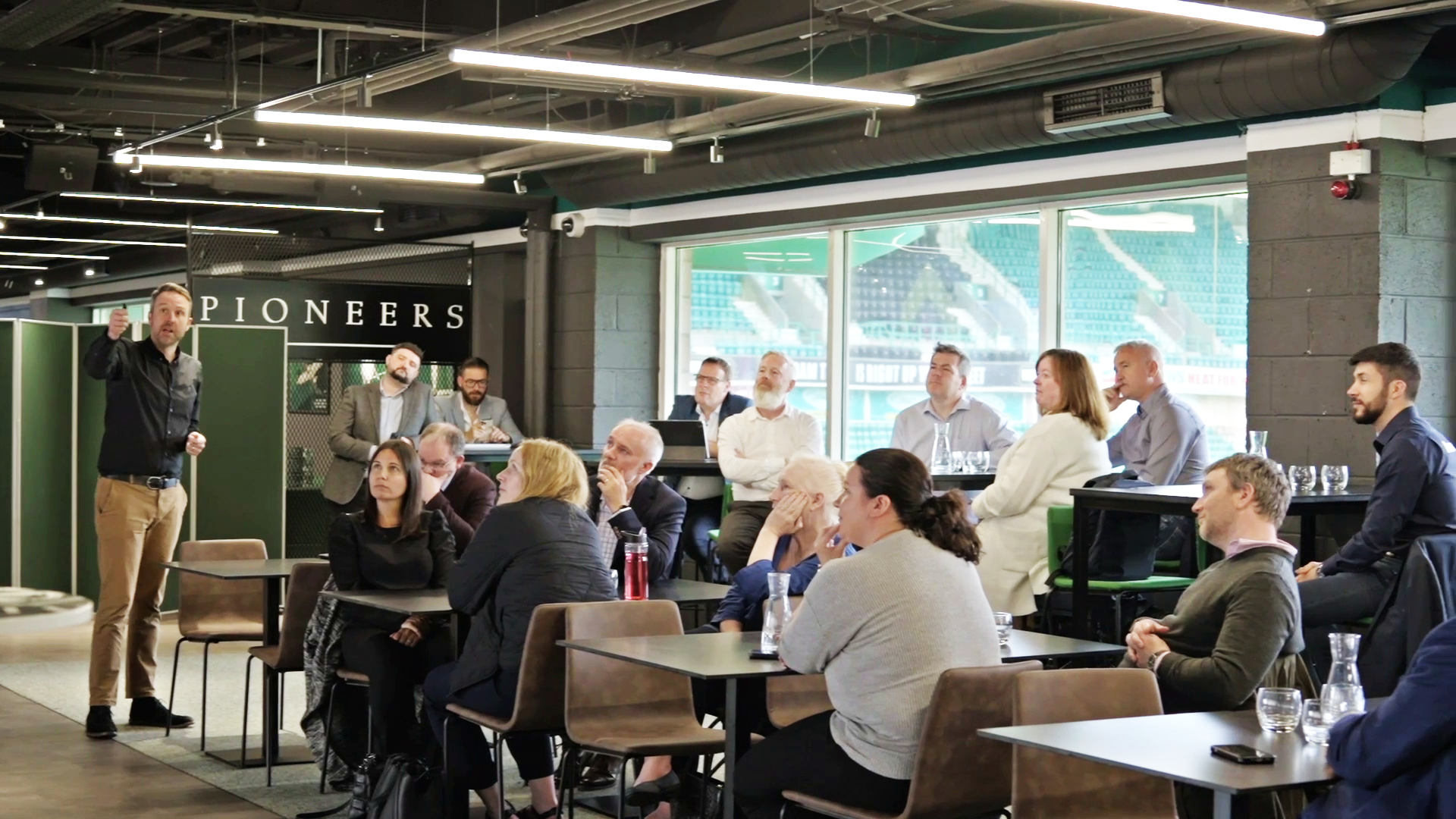
Easter Road felt like a culmination point, not just an event, but the latest step in a journey we've been on since the AI boom began.
It started in December 2023, when Dunedin IT won a SuperOps AI Award, recognition for early adoption at a time when most businesses were still figuring out what to make of it all. Our first AI event in March 2024 was deliberately exploratory, the message was simple: be curious, be playful, find out what works. By June 2024, we were hosting a Modern Workplace event with partners, broadening the conversation.
In August 2025, our Beyond the Icing webinar introduced the intelligence layer concept, using a cake metaphor to explain what sits beneath the tools. A month later, the Hibs Business Breakfast took a Wizard of Oz approach: pulling back the curtain on AI to understand it for what it actually is. By March 2026, Jamie was sitting on a panel at an Egnyte event, sharing how we'd been putting these ideas into practice.
Easter Road was where all of that thinking came together into something clearer: a structured, confident message about what AI-native businesses actually look like.
Behind much of this work sits Ada, our internal AI platform, our own version of the Octopus model in practice.
Looking Ahead
The organisations that gain the most from AI won't necessarily be those using the most tools.
They'll be the ones that redesign how information flows, how decisions get made, and how knowledge is shared across the business.
In other words, they'll become AI-native businesses.
That's the future we explored at Easter Road, and it's arriving faster than many organisations realise. If you'd like to discuss how your organisation can start building those foundations, we'd be happy to continue the conversation.